Real Horrorshow / Midnight Transmission / printable archive
01 / Midnight Transmission / Issue 001

Midnight Transmission

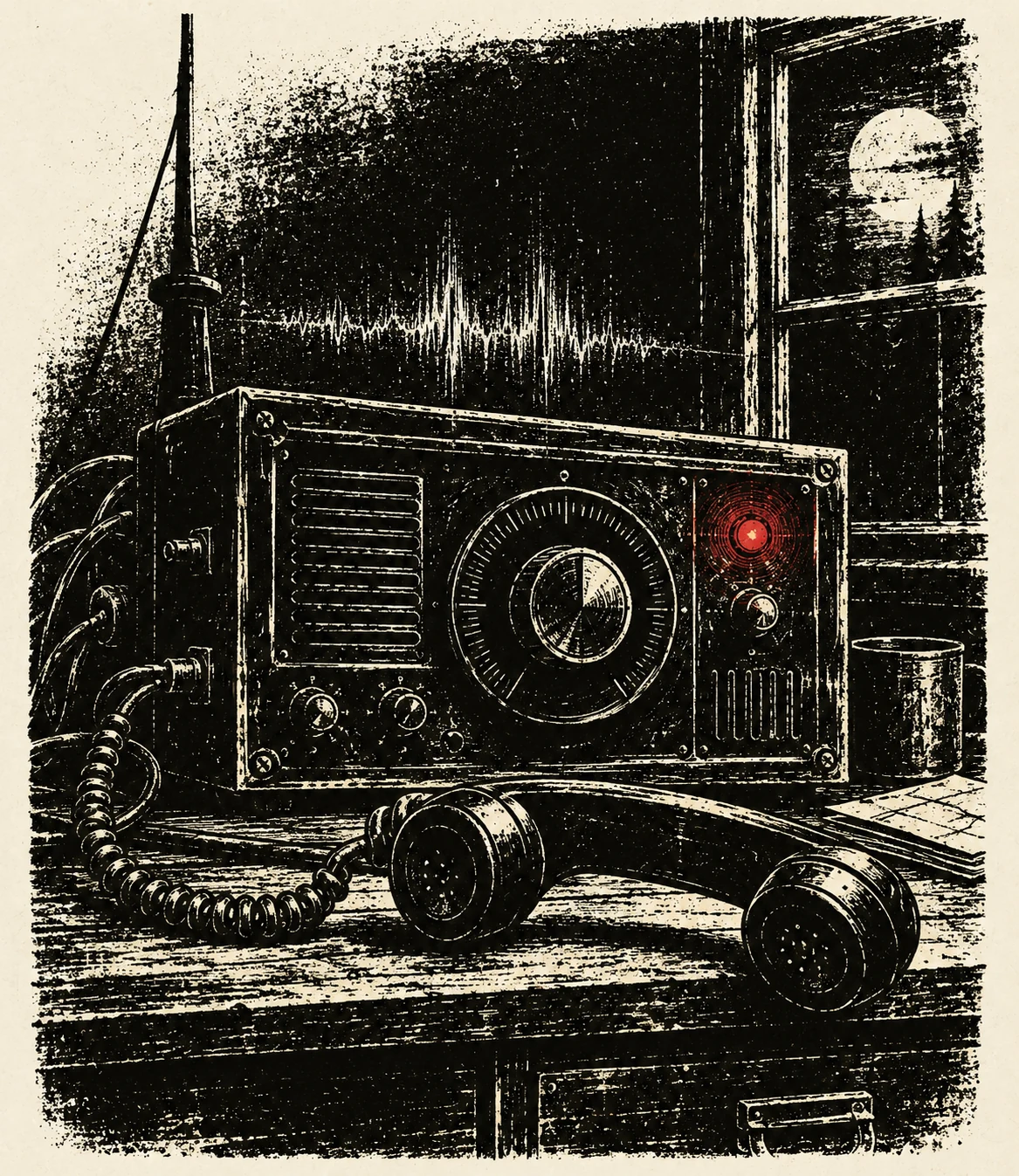
Ink illustration of an abandoned radio switchboard and receiver

Original fiction. The station, motel, specimens, recordings, and notices are invented; no real service or destination is described.

Issue 001: The address after the address

A station with no transmitter. A motel room with an extra voice. One small creature whose antennae lean toward the sound before it happens.

Real Horrorshow presents eight pieces from the dead channel. Everything that follows is invented, including the notices. Take your time at the first blank space. It may be where the message begins.

A fiction issue from the Real Horrorshow studio.

02 / Midnight Transmission / Issue 001

From the dead-channel desk

Some places keep a mailbox after the building comes down. The post office forwards what it can and eventually sends the rest back. Radio is less courteous. A voice can go on looking for an address long after the street changes its name.

This issue began with that thought, not with a recovered tape or a genuine haunting. The station, motel, notices, and recordings in these pages are fictional. The illustrated specimen is an imagined study, not an animal collected from the wild. I want to say so here, while the lights are on, because the pleasure of a good counterfeit document depends on the reader being free to play along. It shouldn't depend on somebody mistaking it for a real warning.

In our made-up town, the maintenance station called WNDR closed when its antenna was pulled down. Its test frequency remained on a municipal list nobody revised. The machine that once said where to shelter during storms now repeats the final line of any message fed into its dead input: "State the address after the address." Nobody can explain what that means. There are theories. The least satisfying one is that a technician had a joke he expected another technician to hear.

The pages ahead refuse the tidy explanation. Dead Channel No. 001 follows a night operator taking calls at a station that no longer has a night operator. Antenna 018 asks what a signal might look like to an insect. Room Tone is a motel report in which a quiet room seems to know the name of its next guest. The classifieds are what happens when a town starts treating the frequency like a bulletin board. Read them as artifacts from the same invented place; none is a real ad, phone number, or invitation to visit somewhere.

The dead channel is this issue's writing desk; the after-hours cabinet is the studio's visual shelf. A specimen number can recur in a story without making a drawing a scientific record or a product promise. Watch what people preserve: a card, a recording, a note. The frequency never keeps the part they most want back.

— The dead-channel desk, Real Horrorshow

03 / Midnight Transmission / Issue 001

Dead Channel No. 001

Fiction / transmission fragment

The switchboard still had seven keys. All seven lit when I plugged it in, although the building's power had been cut three winters ago.

I had a flashlight, a battery recorder, and a work order telling me to remove the board before the demolition crew arrived. I was not supposed to answer calls. I had been hired to move equipment, not voices. Then the leftmost key blinked and a woman said, "I'm at the address. There's no house."

I told her she had the wrong number. She told me the number printed on her card, and it was the station's old number. I knew because I'd found a box of those cards that afternoon. They advertised WNDR's storm shelter line in blue ink that had faded to the color of a vein.

"Which address?" I asked.

"The first one," she said. "There's supposed to be another."

A crackle came between us, soft and dry. I had been listening to mice in the wall all evening. This was different: the sound of paper being folded at the other end of a phone.

I looked at the work order: 14 Mercer Cut. A blue station card said, in pencil, If the building is gone, state the address after the address. No second address followed.

The woman said she was standing in gravel. She could see the footprint of a porch, and four clean squares where its supports had been. She described a mailbox on a post with no number. The description matched nothing I knew. I could hear her breathing, not traffic. I asked whether she was safe, whether someone could come get her. She said yes to the first and ignored the second.

"I brought his message," she said.

She had a paper grocery bag. Inside was a cassette in a plastic case with a narrow white label. Her father had recorded the shelter instructions, she said. After his death she found the tape among the holiday decorations. She played it at home and heard him clear his throat before the official announcement. He had always cleared his throat twice before telling her something he didn't want to say.

"Only once on the tape," she said. "I've been waiting for the other one."

This is the point at which I should have explained that WNDR couldn't receive cassette audio over a phone line unless she played it into the receiver. Instead I asked her to play it. I put the battery recorder beside the switchboard.

Her father said to use the school gym during severe weather. He said the gym's west entrance remained open after hours. I could hear a click where the tape had been stopped and started again. Then, in a much quieter voice, he said, "Nell, if you come looking, don't use the house." The line ended there.

The woman's name was not Nell. She said her father had never mentioned anyone by that name. The tape had sat for years in a box of tinsel, and I couldn't tell whether the second voice was her father's or an ordinary voice reaching me through a bad connection.

I offered to call the police non-emergency line for her. She said she didn't need police. She wanted the rest of the tape, the part she was certain had been erased. She asked me to listen for the throat-clearing again.

The recorder's counter rolled. On the phone there was a rustle, a faint click, and the familiar synthetic voice of the old station ID: "State the address after the address."

"That isn't on the tape," she said.

The board's seven keys went dark in sequence. The last one stayed lit, the one marked AUX. No wire ran to it. I checked because a loose wire was still a better answer than what I wanted to believe. The key went dark when I touched it.

I took the board out the next morning. The demolition crew wouldn't wait for anyone's ghost. I took the cards too, because the back of each one had a different pencil mark: a dash, a small square, a line that almost made a letter. I put them in order and got nothing useful. That was a relief. It meant I could tell the woman I hadn't found an address, if I ever found a way to call her.

When I played my recorder back, I heard the shelter announcement and the station ID. I didn't hear the woman's voice. On the work order, below the station address, someone had added a forwarding address for salvaged equipment: Room 13, Bellwether Motor Court. It was typed in the same font as the rest. I had missed it because it was under a staple.

I did not go there that night. I had the board in my van and enough money for the job. The following afternoon, I went because I was ashamed of how easy it had been to leave.

Bellwether was open. The clerk told me Room 13 had no television and charged less for it. I asked if they took station equipment. He said, "People leave all kinds of things." He gave me a key with a watchful little keyhole printed on the tag. At the door, the room was quiet enough that I could hear someone clear their throat once on the other side.
04 / Midnight Transmission / Issue 001

Specimen Log: Antenna 018

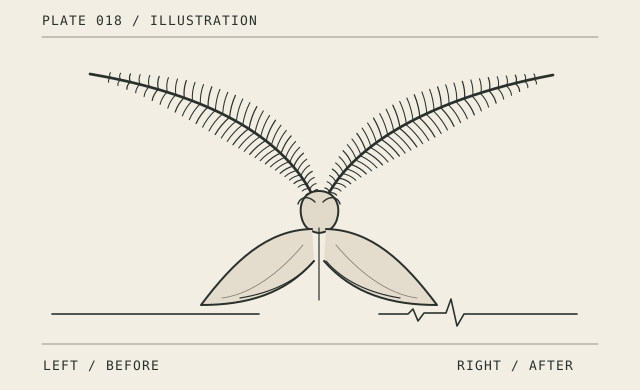
Illustrated folded-wing moth with two finely feathered antennae, left before and right after
Illustration / imagined specimen, not a scientific record.

Fictional art plate / imagined specimen label.

Plate description: Two feathered antennae, detached from the body only by the frame of the drawing. One leans toward a narrow printed waveform at the plate's edge. Below, a moth with folded wings sits on a windowsill; the room beyond is drawn almost empty. A small legend reads: LEFT / BEFORE, RIGHT / AFTER. That legend belongs to the story, not biology.

Cabinet label, 018. A moth finds its way through the dark without understanding the lamp. The antenna does work the eye cannot do. It reads air, traces, presence. On this invented plate, the right antenna bends toward a sound that has yet to be made. The left stays where the sound was. The gap between them is the time it takes a person to decide whether to answer.

The drawing's owner, an unnamed collector in the issue's fictional town, labels things to make them less frightening. The cabinet has paper slips for a tooth, an ear bone, a seed capsule. This slip gives the moth a number. It also gives it a job: whenever the motel's Room 13 is empty, the collector places the plate opposite the door and watches the illustrated antennae. On one visit the right antenna appears to have shifted. The paper hasn't moved in its frame. The collector measures the line with a ruler and gets the same measurement twice. On the third attempt, the motel's ice machine starts and the shift is gone.

There is no need for the moth to be magical. The collector may have hung the frame crooked. Someone may have changed the drawing. The paper may have bowed. What matters is what the collector does next: instead of putting a camera on the frame, they put a microphone in Room 13. A picture that could be wrong has taught them to listen.

The small printed waveform at the edge of the plate has a long flat portion. It resembles the quiet on a tape after the speaker thinks the recorder has stopped. Against that flat line is one tiny rise. It might be a throat being cleared. It might be a drawer closing in the next room. The illustrator has left enough space around it for either.

Margin note from the fictional collector: "Antennae don't receive radio broadcasts. That's my guess when I'm afraid to write the other one: I kept seeing it lean toward the door, and I wanted a reason to stay."

Turn the page for the room the collector decided to record.

05 / Midnight Transmission / Issue 001

Field Report: Room Tone

Fiction / field report.

Location: Room 13, Bellwether Motor Court. Recorder: the collector from Plate 018, named here only as the keeper. Purpose: record an empty room overnight. Account assembled from the keeper's notebook and a fictional transcript.

The keeper rented Room 13 for two nights and spent neither night in it. The first afternoon they placed a recorder on the dresser and tested it by reading the room's laminated rules: no smoking, no pets, leave the key at the desk. They checked playback before going home. The little speaker reproduced their voice and the ice machine outside. Ordinary sounds, mercifully ordinary.

At 9:40 p.m. the clerk walked down the corridor and knocked to ask if the guest needed fresh towels. The keeper had left a DO NOT DISTURB card on the handle. The clerk admitted later that he knocked anyway because the room had made a sound like its television was on. Room 13 had no television. He didn't open the door; he called out, got no answer, and went back to the office. A ledger recorded one key for the room, issued to the keeper. It doesn't prove nobody entered. It does prove the clerk had a simple, plausible reason to be near the door.

The recording contains a soft electric hum from the ice machine, then the clerk's knock. His voice is too muffled to transcribe. At 9:43, the recorder catches footsteps crossing the room. They stop near the dresser. The footsteps could belong to someone inside, or they could be corridor steps carried through the wall and changed by the microphone's position. The keeper drew a floor plan later, as if a line on paper could settle the matter.

At 9:44 there is a voice. Not a whisper. It has the slightly flat tone of someone reading from a form: "One key. One room. One person due." The room is otherwise silent for nearly a minute. The voice comes again, farther from the recorder: "Which address?"

The keeper listened to that section until the batteries failed. They heard a woman in the first line, a man in the second. The clerk heard the same voice both times. Neither could identify it. The transcript preserves the words but does not pretend that two listeners agreeing would tell us who spoke.

The next afternoon, the station worker arrived carrying the salvaged switchboard. The keeper was at the desk trying to explain why they wanted another night in Room 13. The worker said they'd found a forwarding address on a WNDR work order. The keeper asked to see it. Across the line for Room 13 was the typed instruction: FORWARD EQUIPMENT ONLY. DO NOT FORWARD CALLS.

That second sentence was new to the worker. They were sure it hadn't been there before. The keeper was sure it had: they had copied it into their notebook the previous week after finding an identical line in a box of auction papers. Neither notebook nor work order could adjudicate memory. The paper's staple holes did show that the instruction had been under a cover sheet, and the worker had never removed the staple. The keeper didn't say "I told you so." They bought coffee for both of them instead.

Together they carried the switchboard into Room 13. It was heavy, harmless when unplugged, and left a dark rectangular mark on the dresser dust. The keeper put fresh batteries in the recorder. They turned the board to face the wall and read aloud the words on the work order so the new tape would have a clean reference. Then they unplugged the recorder and played back the first night's tape once, all the way through.

At 9:44, after "Which address?", there was a third line neither of them had heard in the office: "The one someone can reach." The keeper wrote it down without trying to find a speaker. The worker opened the room door. The clerk was halfway down the corridor with towels in his hands. He asked whether they were staying another night.

The worker said no. The keeper said yes. They looked at each other, surprised at the disagreement, then laughed because the clerk had asked an ordinary question and deserved an ordinary answer. The keeper stayed, not to bait a ghost but to make sure the room could still be slept in. They switched off the recorder. They slept badly and dreamed of a mailbox without a house. In the morning the room sounded like an ice machine, traffic, and a guest dragging a suitcase over concrete.

The keeper left the cassette in an envelope at the front desk marked FOR THE WOMAN WITH THE GROCERY BAG, if she ever arrived. The clerk refused to promise he would recognize her. He put it in the lost-and-found drawer anyway, beside a single blue card from WNDR. On the back of that card someone had written, in careful block letters, BELLWETHER / ROOM 13. No second address. The station worker had brought a stack of cards in the van and could easily have left one. The keeper could have written it there. The clerk didn't ask.

The clerk shut the drawer. He had promised nobody anything, and for once he was glad of it.

06 / Midnight Transmission / Issue 001

After-hours classifieds

Original fiction. The station, motel, specimens, recordings, and notices are invented; no real service or destination is described.

Fictional notices from the invented town. All addresses and contact methods below are in-story only. These are not real offers, services, or submission instructions.

LOST / One voice on a weather tape. The tape plays through, the speaker clears his throat once, and the next breath is missing. Not seeking a replacement voice. If you found the breath, leave it with the clerk. Do not splice it in yourself.

FOUND / Blue card. Printed storm instructions; pencil marks on reverse. Found beneath an unplugged switchboard. Owner may describe the mark without looking at the card. This is less a test than an attempt to avoid giving it to the wrong person twice.

ROOM AVAILABLE / Bellwether 13. No television. Ice machine outside. Discount if you can sleep through the corridor. Management does not guarantee quiet, only a key that turns.

WANTED / Straight ruler. For measuring a drawing that refuses to change while I watch it. Wooden preferred. I have broken two plastic ones in the same place and would like to blame the plastic.

SERVICE / Label repair. Faded ink, lifted corners, numbers out of sequence. I will restore a label's legibility, not the thing it was attached to. Bring the paper, not the specimen.

NOTICE / The old shelter line is closed. The blue cards have not been valid since the antenna came down. If a storm comes through, the driver knows which gym is open. Ask while the buses are still running.

FOR SALE / An empty frame. Its backing is stained in the shape of two antennae. The glass is sound. Buyer may hang a different picture in it; seller would genuinely prefer that.

PERSONAL / To the person who left the envelope. You wrote "if she ever arrives" as though arrival were a favor the world owed you. I arrived on Thursday. The desk clerk gave me a key instead. I slept. I will return the key in the morning.

PUBLIC NOTE / Final delivery. The post box at Mercer Cut has been removed. Anything left in its former place will be swept up with the gravel. Write to a living person, if you can. Say where they can find you.

07 / Midnight Transmission / Issue 001

How the static got made

Editorial craft note on the fiction in this issue.

We could have given the station a sinister name and let it explain the mystery. That would be the easiest version. Instead the signal has an administrative task: it asks for a forwarding address. It can't find people by itself. The horror comes from the gap between a machine that still gives instructions and people who need it to know whom those instructions are for.

The switchboard has seven keys because a hand needs something finite to touch. The cards are blue because a specific, unromantic object beats a fog of cursed paper. The motel's ice machine is loud enough to offer a mundane explanation for the tape. Those details don't cancel the uncanny possibility. They keep each character from being forced into one conclusion by the author. Nobody in Room 13 has to prove they are brave, and the woman with the grocery bag gets to want a second throat-clearing without having her grief mocked.

Antenna 018 belongs to the drawn cabinet. A moth antenna is not a radio antenna; the story depends on the keeper making that category error and then catching it. The left/right legend is an illustrator's invention, a way to put "before" and "after" on the same sheet. It is not a field guide. If the plate is ever rendered, the specimen should stay visibly illustrated. A real moth photograph under a fake scientific caption would borrow authority the fiction hasn't earned.

The report changes the pace. The first story gives us an unanswered door; the plate detours through a crooked frame; the report lets three people disagree without making one the villain. The third line on the tape offers a feeling, not proof of who spoke. The classifieds make room for a town to behave like a town, right down to an outdated shelter notice that somebody still needs to correct.

The numbered plate and the keyhole belong to this fiction's visual grammar. They may suggest other stories, but the page does not have to sell an object or certify a specimen to do its work.

I like the last classified because it refuses the big reveal. The caller wanted her father's missing breath. The station worker wanted a clean removal job. The keeper wanted a line on a tape to resolve into a person. None gets exactly that. A key is handed over; an envelope sits in a drawer; the morning sounds ordinary again. That's the kind of ending this first transmission can afford. The next issue does not have to rescue this one.

08 / Midnight Transmission / Issue 001

Last call, after the signal

Closing letter / Issue 001 is complete without reader submissions.

The clerk puts the blue card under the counter. The woman returns the key. Nobody checks the drawer while she's there. We can leave them that privacy.

Thank you for reading the first issue. The dead channel is our fictional editorial frequency: a place to let strange stories find one another. There is no missing address for you to track down outside these pages.

Issue 001 closes here. We may invite original fragments or artwork for a later issue, but there is no open call or deadline. You can simply read this one and leave the channel quiet.

In the invented town, the clerk eventually opens the lost-and-found drawer. The envelope is still there. On its face the words FOR THE WOMAN WITH THE GROCERY BAG have been crossed out, gently enough that he can read them. Below them someone has written: SHE HAS AN ADDRESS NOW.

He does not put the envelope in the mail. He keeps it where she can ask for it.

End of Issue 001. Original fiction from the Real Horrorshow dead-channel desk.